
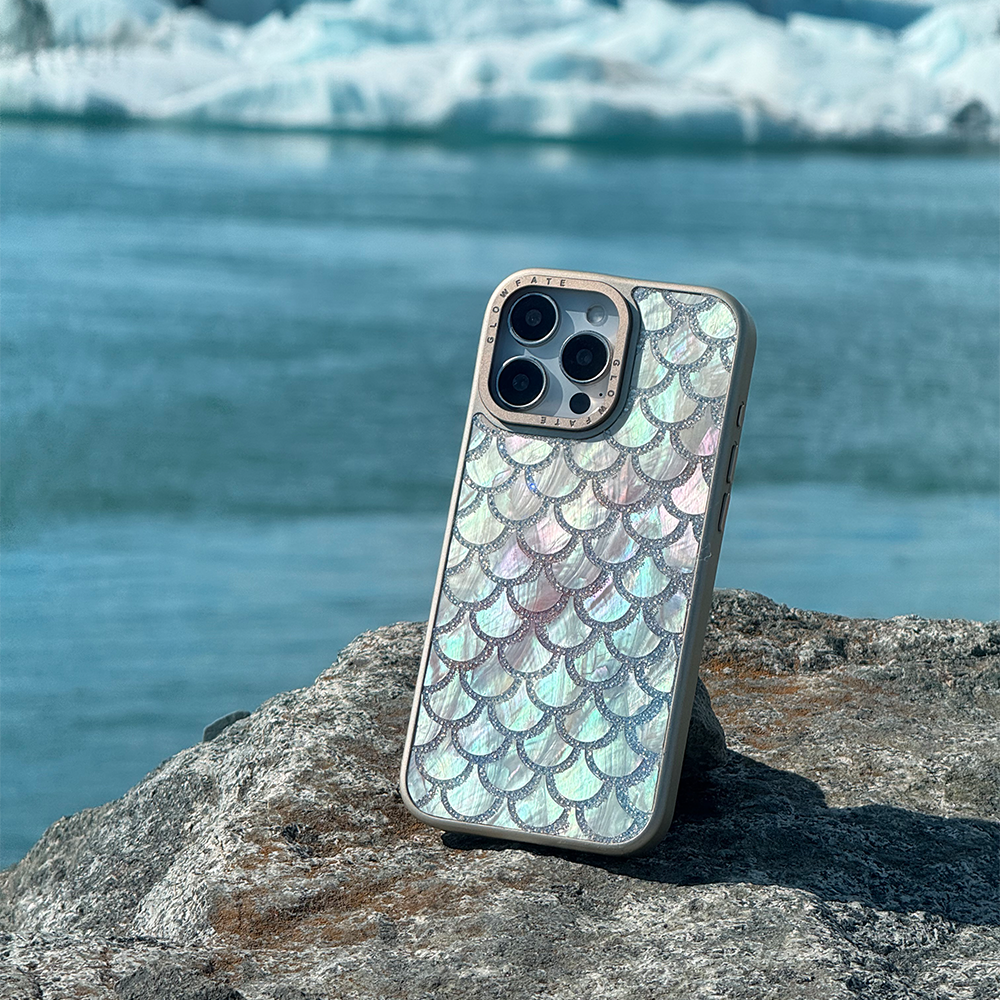
Have you ever wondered—
What’s the story behind the phone case you hold in your hands every day?
Most phone cases on the market are mass-produced by machines and look exactly the same.
But our seashell and crystal phone cases are different.
Every single seashell truly comes from the ocean.
Every crystal is hand-selected.
Every phone case goes through 7 handcrafted steps before it reaches your hands.
Today, we’ll take you through the production process.
Step 1: Collecting and Selecting Shells
The shells we use are not harvested from living creatures, and we do not harm the marine ecosystem.
Our shells come from:
Shells from naturally deceased creatures
Fragments safely collected along the shoreline
Shell resources recycled in partnership with coastal communities
Every piece of shell undergoes three rounds of manual screening:
Removing severely damaged shells unsuitable for inlay
Sorting by color (white, pink, gold, gray, blue)
Sorting by texture (spiral, striped, pearlescent)
🌊 Only about 30% of the shells are selected for use in phone cases.
Step 2: Crystal Selection and Purification
We don’t just buy any crystals.
The crystals we select must meet the following criteria:
Natural and unaltered (no dyeing or heat treatment)
Clarity of medium or higher
Size that matches the phone case surface
Before inlaying, the crystals undergo a simple purification process (rinsing with clean water + air-drying),
preserving their original energy and transparency.
Step 3: Preparing the Phone Case Base
We use TPU phone cases as the base.
Before hand-setting:
Thoroughly clean the surface (oil-free, dust-free)
Mark the placement areas for shells and crystals
Reserve spaces for the camera, buttons, and logo
Step 4: Hand-Placement and Composition (The Most Critical Step)
No machines are involved in this step.
Our artisans will:
Place each shell piece by hand
Create gradients or contrasts based on color and texture
Embed crystals in the gaps
The texture of every phone case is one-of-a-kind.
No two cases of the same design will ever be exactly alike.
✨ This is why many customers say:
“My shell phone case is the only one of its kind in the world.”
Step 5: Resin Coating and Sealing
To ensure the shells and crystals stay securely in place and are water-resistant,
we use a high-transparency, yellowing-resistant crystal resin (epoxy resin).
Process:
Mix the resin and hardener in the correct ratio
Evenly coat the surfaces of the shells and crystals
Let it sit to allow natural leveling
Wait 12–24 hours for complete curing
Benefits of this process:
The shell won’t cut your hands or scratch surfaces
Waterproof, dustproof, and resistant to minor bumps
Retains its natural luster
Step 6: Sanding and Edge Finishing
After curing, there may be slight resin overflow along the edges of the phone case.
Hand-sanding steps:
Gently sand the edges with fine-grit sandpaper
Check that the camera and button holes are clear
Clean the surface a second time
Step 7: Final Quality Inspection and Packaging
Every phone case undergoes the following checks before shipping:
✅ Is the shell securely attached?
✅ Is the crystal clear and free of impurities?
✅ Is the resin smooth and even?
✅ Are the cutouts precise?
Finally, each case is shipped in eco-friendly packaging.
Conclusion: You can own a handcrafted piece like this
We don’t make disposable, fast-moving consumer goods.
What we create are phone cases that will last a long time and are worth cherishing.
If you also appreciate:
Natural materials
Unique textures
The warmth of handcrafted artistry
👉 Click here to see which shell phone cases are available today